
Don't Fry Your Phone: The Ultimate Social-Ready Guide to Eclipse Photography (and Where to Watch It!)

Let’s be honest: when the Moon slides across the Sun and day turns into an eerie, twilight-purple afternoon, your first instinct isn’t going to be calculating shutter speeds or fussing with an aperture ring. You’re going to whip out your smartphone, gasp, and try to capture the magic.
And that is entirely okay. But before you point your favorite pocket computer directly at our local star, let’s talk about a hard truth: yes, you can damage your phone camera, and no, a blurry white smudge of the sun is not going viral on your feed.
As professional astronomy guides, we want your eclipse experience to be legendary—both for your followers and for your peace of mind. Here is your snappy, zero-jargon guide to snapping incredible, phone-friendly eclipse shots without melting your sensor or missing the show.
1. Don’t Fry Your Phone (The Eclipse Safety Lowdown)
We’ve all heard that looking at an eclipse without proper protection will damage your eyes . But what about your phone?
While your phone sensor isn't a human retina, focusing concentrated sunlight through a modern multi-lens smartphone array can overheat internal components, melt delicate plastic parts, or permanently burn out your sensor. More importantly, if you try to film the partial phase without a filter, your footage will look like a blinding, overexposed flashlight.
The golden rule is simple:
During partial or annular phases, your camera needs a proper, front-mounted solar filter (compliant with ISO 12312-2 standards or certified optical film) .
During totality (the magical 100% dark phase when the corona flashes out), you must take the filter off so you can actually capture the solar atmosphere . If you aren’t in the path of totality, the filter stays on the entire time .
Never use sunglasses, smoked glass, X-ray film, or random plastic wrappers. If it’s not a certified solar filter, leave it out.
2. Stop Pinch-To-Zooming Like a Madman
We see it every eclipse: someone zooms their phone all the way to 30×, ends up with a pixelated grey blob that looks like a stray cotton ball, and wonders why it doesn't look like NASA.
Smartphones rely heavily on digital zoom past their optical limits, which turns your photos into a grainy watercolor painting. Instead, stick to your phone’s native optical sweet spot—usually the 3× or 5× telephoto lens.
Pro tip: If your phone has a Pro mode or manual controls, tap the screen on the Sun, lock your focus (AE/AF Lock), and slide the exposure brightness down until the Sun has a sharp, clean edge instead of a glowing glare . If you're shooting RAW, even better—you'll have way more flexibility to tweak the highlights later.

3. The Ultimate Location Hack: Why You Should Watch the Eclipse from the Sea
Here’s a secret that land-based eclipse chasers often learn the hard way: finding a spot on land with a completely clear western horizon is surprisingly stressful. Hills, buildings, trees, and stubborn coastal clouds can ruin months of planning just seconds before peak eclipse.
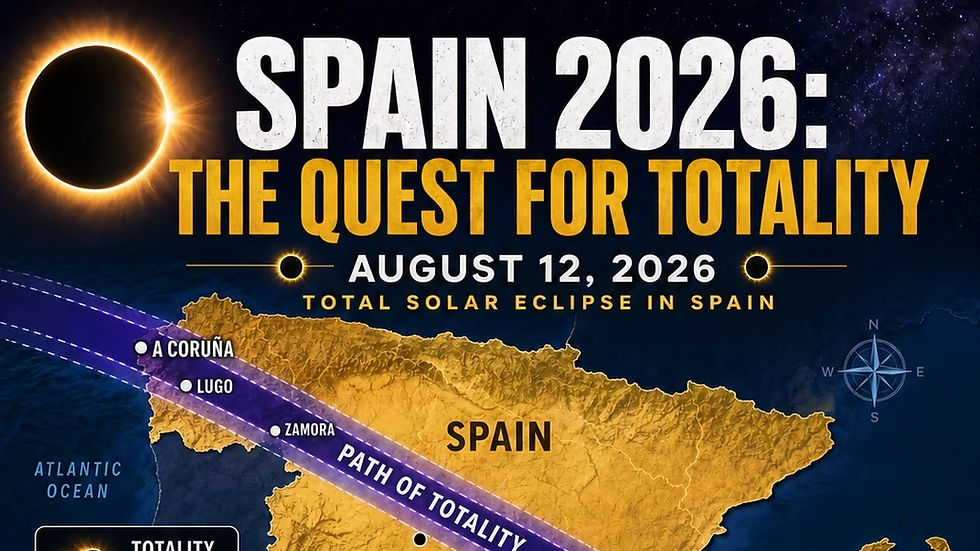
That is why the most spectacular way to experience the upcoming 2026 Solar Eclipse in Spain is from the water.
At Just Stargaze, we curate expert-led catamaran solar eclipse cruises departing from prime coastal spots like Cartagena, Torrevieja, and Santiago de La Ribera. Watching from the deck of a boat gives you the ultimate advantage: an completely unobstructed, 360-degree horizon, zero land obstructions, and the gentle motion of the sea as day turns to night. Whether you need ISO-certified eclipse glasses or want to experience totality from the best seat at sea, our expert guides ensure you're fully prepared.
4. The Real Secret: Put the Phone Down and Enjoy the Moment
Here is the ultimate secret that veteran eclipse chasers swear by: The best part of an eclipse isn’t the Sun. It’s everything happening around you.
When totality hits on the open sea, the temperature plummets, 360-degree sunset colors wrap around the horizon, and everyone on deck gasps in awe. Thousands of professional astrophotographers will have ultra-sharp telescope photos online five minutes after the event .
What they won't have is the priceless video of your reaction, surrounded by fellow astronomy enthusiasts on a sparkling catamaran.

Our favorite pro-tip: Set your phone or compact camera on a small tripod on the deck. Point it away from the Sun toward your group or the sweeping ocean horizon. Hit record on video mode a minute before totality, and let it capture the ambient light change, the shadow rushing across the water, and your group's collective reaction .
Then, put the gear away. Look up. Let the universe blow your mind with your own eyes .
Because when all is said and done, an eclipse is better celebrated than recorded. Ready to trade land-based traffic and blocked horizons for the ultimate front-row seat on the Mediterranean? Check out our upcoming catamaran cruises at Just Stargaze and join us under the shadow!

Comments